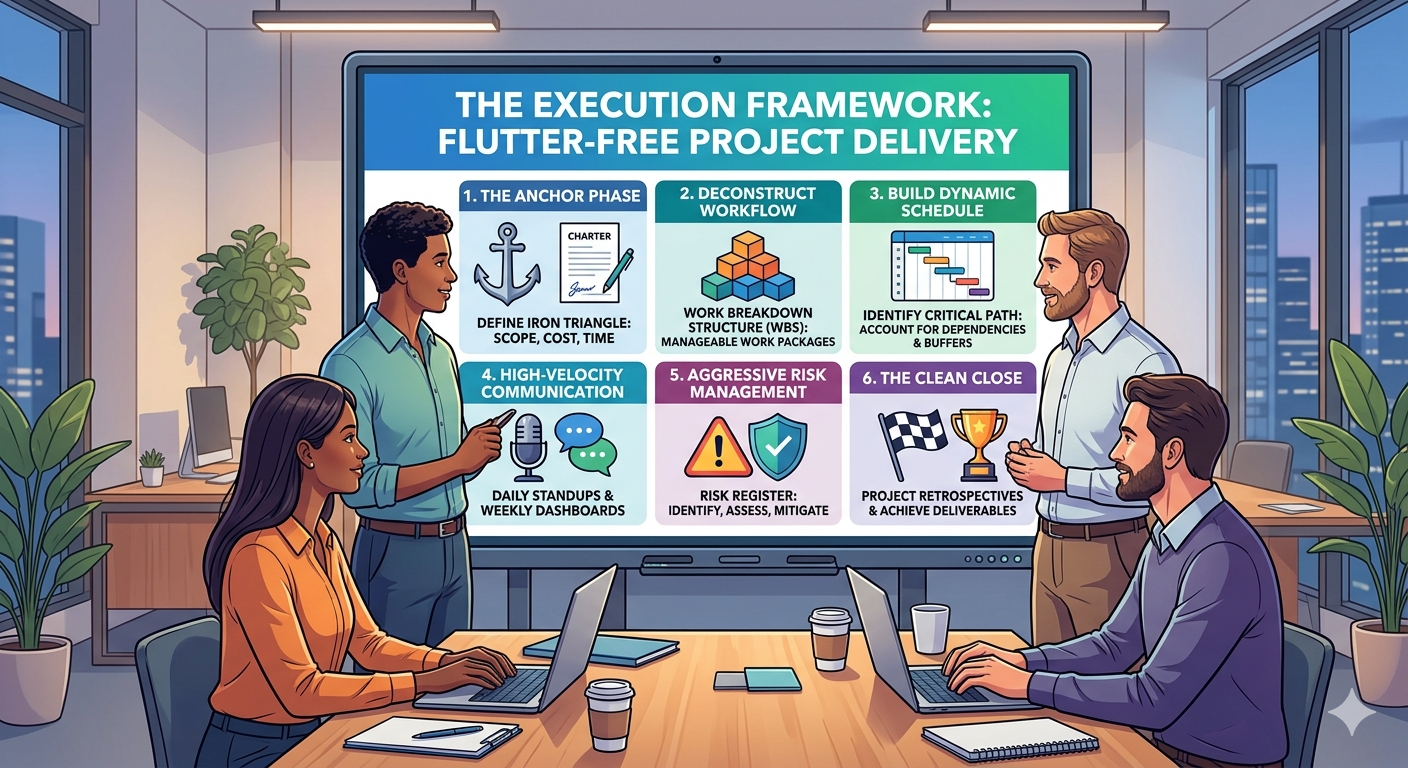
Great project management looks like magic from the outside, but on the inside, it is pure engineering. When a complex engineering system, a software deployment, or a multi-tiered market launch delivers exactly on schedule, it is not because the team got lucky. It is because the project manager eliminated chaos through systematic control.
Most projects do not fail during the final stretch; they fail in the first ten days due to vague scope and unstated assumptions. To achieve flawless execution, you need a repeatable blueprint that bridges the gap between high-level strategy and daily operational reality.
Here is the step-by-step framework to manage any complex project with absolute precision.
1. The Anchor Phase: Define the Iron Triangle
Before a single task is assigned, you must establish the boundaries of the Iron Triangle: Scope, Cost, and Time. If one changes, the others must adjust.
To prevent scope creep—the slow, unmanaged growth of a project's requirements—you must establish a definitive boundary line.
-
The Project Charter: Write a one-page document detailing exactly what the project will deliver, and crucially, what it will not deliver.
-
Stakeholder Alignment: Secure written sign-off on this charter from every major stakeholder. If it is not in the charter, it does not exist in the active sprint or work cycle.
2. Deconstruct the Workflow (The WBS Method)
Do not look at a project as one massive mountain to climb. Break it down into manageable components using a Work Breakdown Structure (WBS). This is the process of decomposing a large project into smaller, isolated deliverables.
-
Phase Level: Divide the project into major historical phases (e.g., Initiation, Design, Testing, Deployment).
-
Work Packages: Break each phase down into distinct packages that a single team or person can own completely.
-
The Two-Week Rule: If a work package takes longer than two weeks to complete, break it down further. Smaller tasks are easier to estimate accurately and harder to hide delays behind.
3. Build a Dynamic Schedule
Static timelines are useless the moment real-world friction occurs. You need a dynamic schedule that accounts for dependencies—tasks that cannot start until a previous task finishes.
-
Identify the Critical Path: Determine the longest sequence of dependent tasks that must be completed on time for the entire project to finish on schedule. A delay in any task on the critical path delays the whole project.
-
Protect the Buffer: Never schedule your team at 100% capacity. Build a 15% buffer into your timeline to absorb unexpected technical roadblocks, supply chain delays, or resource constraints.
4. Establish a High-Velocity Communication Loop
Miscommunication is the primary driver of project friction. Elite project managers do not hold long, draining meetings; they build efficient communication loops.
-
Daily Standups: Keep them strictly under 15 minutes. Every team member answers three questions: What did I finish yesterday? What am I focusing on today? What is blocking my progress?
-
Weekly Dashboards: Send a concise, bulleted status update to stakeholders every Friday. Highlight milestones achieved, upcoming targets, and active risks. Keep it brief, factual, and scannable.
5. Aggressive Risk Management
Passive project managers react to problems; elite project managers anticipate them. Maintain a live Risk Register throughout the lifecycle of the project.
Identify potential failure points early by categorizing them by probability and impact. If a high-probability risk is identified, document a clear mitigation step immediately. If the risk turns into a live issue, you can deploy the pre-planned backup option instantly without panicking.
6. The Clean Close
A project is not finished just because the product is built. The closing phase ensures the organization actually captures the value of the work.
Run a dedicated retrospective meeting with your core team. Document what went well, where the timeline slipped, and how the workflow can be optimized for the next deployment. Archive all engineering drawings, codebase repositories, and financial data in a centralized, accessible location.