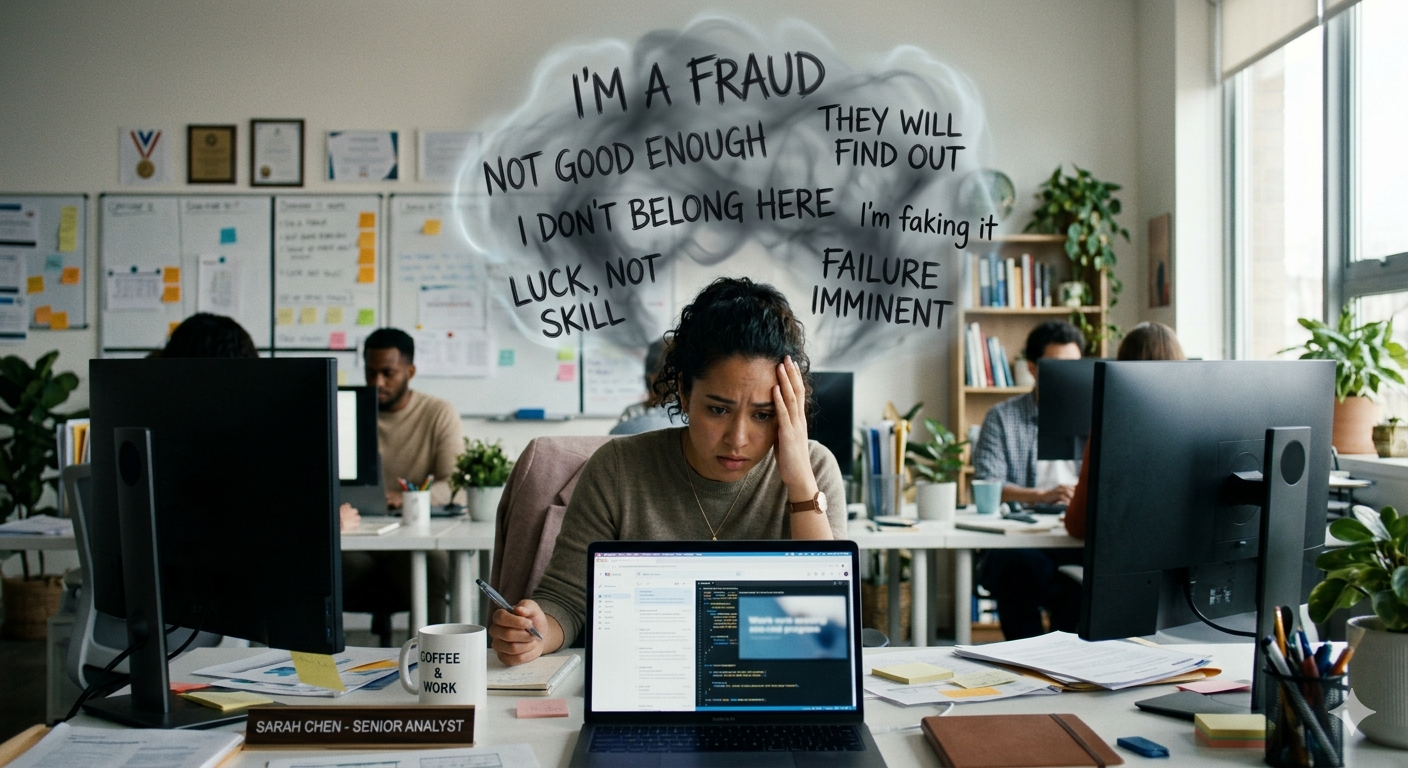
Imposter syndrome is one of the least talked about Psychological phenomena - a permanent fear factor hindering the smooth flow of energy and skills in almost every profession. What fuels Imposter Syndrome—is the awareness of those parts of ourselves we’d rather forget.
I have been a very passionate learner - believing in exercising the best of my skills and knowledge for drawing positive outcomes in personal and professional life - yet the worst fear I have been fighting all my life is "facing the people's judgement - what will people say about me!"
In 2018, when I started my career with one of the famous Corporate organisations in the UK - the worst fear behind every venture, task, and assignment of mine was to bear the opinions of my colleagues:
-
What will they say about my performance?
-
My skills?
-
My understanding of the context and problem-solving skills?
I was considering myself least eligible for being a "Team Player!" I have been struggling with such dilemmas - till my manager shared her knowledge with me about the existence of Imposter Syndrome in a normal human society - in the context of my internal struggle while showing up my true skills and abilities in any of the assigned tasks. She not only explained the absolute reasons behind my fear of taking any initiative or accepting any new assignment or role - the real fear factor behind all this was Imposter Syndrome draining all my energies and the spirit of exhibiting my existing skills and abilities of becoming a team player!
I realised that keeping those “dumbest parts” hidden can cause a disconnect between who am I and who people perceive me to be. We know our flaws, quirks, and lazy dinners, but others only see professional achievements and a polished image. That’s why, when someone recognizes our work, gives us an award, or asks us to lead, it can feel like they’re talking about a stranger. Those awkward, unrefined parts are real, too. For better or worse, they’re what make us relatable.
Think about celebrities we connect with most—aren’t they the ones who embrace their quirks and imperfections? Imagine Taylor Swift’s Eras Tour without her “Errors Tour” moments, like swallowing bugs, stage malfunctions, or yelling “Hey, stop!” Perfection isn’t nearly as compelling as authenticity. We need to reclaim the “dumbest parts” of ourselves, and instead of letting them fuel imposter syndrome, see them as proof of our growth, resilience, and realness.
On paper, I know I’m an adult. If nothing else, my birthdate gives it away. I’m making big decisions, managing projects, sitting on nonprofit boards, even mentoring others. But inside, that teenage self still lingers—the one who once got not one but two cars stuck in a flooded ditch because I thought I could make it through, and who was suspended from college for a semester for skipping class and then pretended to my family that I was still enrolled.
The key to feeling like we belong—whether in a boardroom or on a stage—isn’t about hiding our quirks and “dumbest parts” but about accepting them. We carry all those past versions of ourselves with us, and each one has taught us something valuable. Those cringe-worthy moments remind us to stay grounded, to have empathy, and to never take ourselves too seriously.
"In the end, feeling like an imposter might just mean we’re human. It reminds us that we don’t have to feel like adults to contribute something meaningful. We’re here not because we’ve perfected every part of ourselves. We’re here because we keep showing up, willing to do the work even when we don’t feel fully ready. Our insecurities and quirks don’t disqualify us from the table; they make us a little more whole and a lot more relatable. The truth is the real imposters are the ones who pretend they never feel that tension or those doubts."
— Alexandra McClain, Director of Fundraising for Myers-Davis Life Coaching

The Factors Behind Imposter Syndrome
Imposter syndrome is driven by a complex mix of internal personality traits, early childhood experiences, and external environmental pressures. It thrives on self-doubt and the fear of being exposed as a fraud, despite evidence of success:
1. Personality Traits
-
Perfectionism: Holding yourself to unrealistic standards means that any minor mistake feels like total failure.
-
Neuroticism: A general baseline of anxiety, overthinking, and emotional instability frequently accompanies imposter feelings.
-
Low Self-Efficacy: A core difficulty in believing in your own skills and abilities.
2. Family Dynamics & Upbringing
-
Excessive Criticism or High Expectations: Growing up in environments where mistakes were heavily criticized or love felt conditional upon success.
-
Early Labeling: Being labeled "the smart one" can lead to pressure to constantly prove your worth.
-
Overprotection: Caregivers doing everything for you or expressing doubt in your ability can lead to an ongoing inability to trust your own competence.
3. Environment & Social Pressures
-
Being the "Only": Feeling like an outsider due to gender, ethnicity, race, or age often triggers imposter feelings.
-
Highly Competitive Cultures: Workplaces or academic programs that emphasize constant comparison and ranking.
-
Transitions: Major life milestones, like starting a new job, taking a new training course, or getting a promotion.
4. Cognitive Distortions
-
Discounting Positives: Attributing all successes to luck, timing, or external factors rather than your own competence.
-
All-or-Nothing Thinking: The belief that if you aren't perfect, you are a complete failure may cause anyone to fall victim to failure.
Author Clare Josa, writer of Ditching Imposter Syndrome, identifies the four P's associated with imposter syndrome: perfectionism, paralysis, people-pleasing, and procrastination.
How to Tackle Imposter Syndrome
Imposter Syndrome is more common than you might think, affecting 70% of people at some point in their lives, with women experiencing it more frequently than men. These feelings can have significant impacts on both our personal and professional lives, potentially leading to loss of relationships and burnout.
It’s all about how we frame it in our minds and how we talk to ourselves:
-
Listen, Acknowledge, and Accept: Instead of dismissing it, we should listen, acknowledge and accept it, and understand what it’s trying to teach us.
-
Reframe as Opportunity: If you see imposter syndrome as an opportunity to grow rather than a gap in your knowledge, you can make it work for you.
-
A Source of Self-Awareness: After all, this internal dialogue can be a valuable source of self-awareness – view it as not what you lack but where you can grow.
"I'm My Own Dog"
Song by Sidney Gish (2019)
Unfortunately, I am
My own dog, my own fur companion
My own old lady on a forum
Who types in glittery decorum
Unfortunately, I take
Myself out walking every day and
I hand my legs to the feet and
I give my head to the leash
Every other day, I'm wondering
"What's a human being gotta be like?
What's a way to just be competent?"
These sweet instincts ruin my life
Every other day, I'm wondering
"Was it a mistake to try and define
What I'm certain's mad incompetence?"
These sweet instincts ruin my life
I can't smell well, or tell the time
Not K through 8, nor K dash 9
For human, grossly underqualified
For canine, grossly overqualified
I don't blend in at PetSmart
And that truth remains at the Walmart
'Cause in either case, they say to me
"What the fuck is lost in aisle three?"
Every other day, I'm wondering
"What's a human being gotta be like?
What's a way to just be competent?"
These sweet instincts ruin my life
Every other day, I'm wondering
"Was it a mistake to try and define
What I'm certain's mad incompetence?"
These sweet instincts ruin my life
Just watch me, moving far away
Nobody even knows my name, and
No one suspects that I'm not fine, and
Nobody outs behavioral Frankenstein
Just look at Victor in LA
And Syd with the "Y" at U of A
And all the majors at the labels
Rebooting soon as I am able
Every other day, I'm wondering
"What's a human being gotta be like?
What's a way to just be competent?"
These sweet instincts ruin my life
Every other day, I'm wondering
"Was it a mistake to try and define
What I'm certain's mad incompetence?"
These sweet instincts ruin my life
Da-da-da-da-da-da, da-da-da
Da-da-da-da-da-da, da-da-da, da
Da-da-da-da-da-da, da-da-da
These sweet instincts ruin my life
Da-da-da-da-da-da, da-da-da
Da-da-da-da-da-da, da-da-da, da
Da-da-da-da-da-da, da-da-da
These sweet instincts ruin my life